Sunday, 27 June 2010

Scawby Hall, The Laughing Coachman


According to tradition, one dark and stormy night, a coach was being driven on the road between Scawby and Broughton. The coachman, who had been freely partaking of the local ale at the village inn, cracked his whip laughing and shouting as he urged the horses to a frenzied gallop.
“Through the furious night they raced, then suddenly they swung away from the road, dashed across the fields, and, with a resounding splash, coach, horses, and coachman disappeared beneath the water of the pond in the grounds of Scawby Hall.”

And on certain nights, it is said, people passing along that road have heard the sound of spectral hoof-beats, the crack of a whip and the maniacal laughter of the drunken coachman

Tuesday, 22 June 2010


The Werewolf of Gedney Dyke
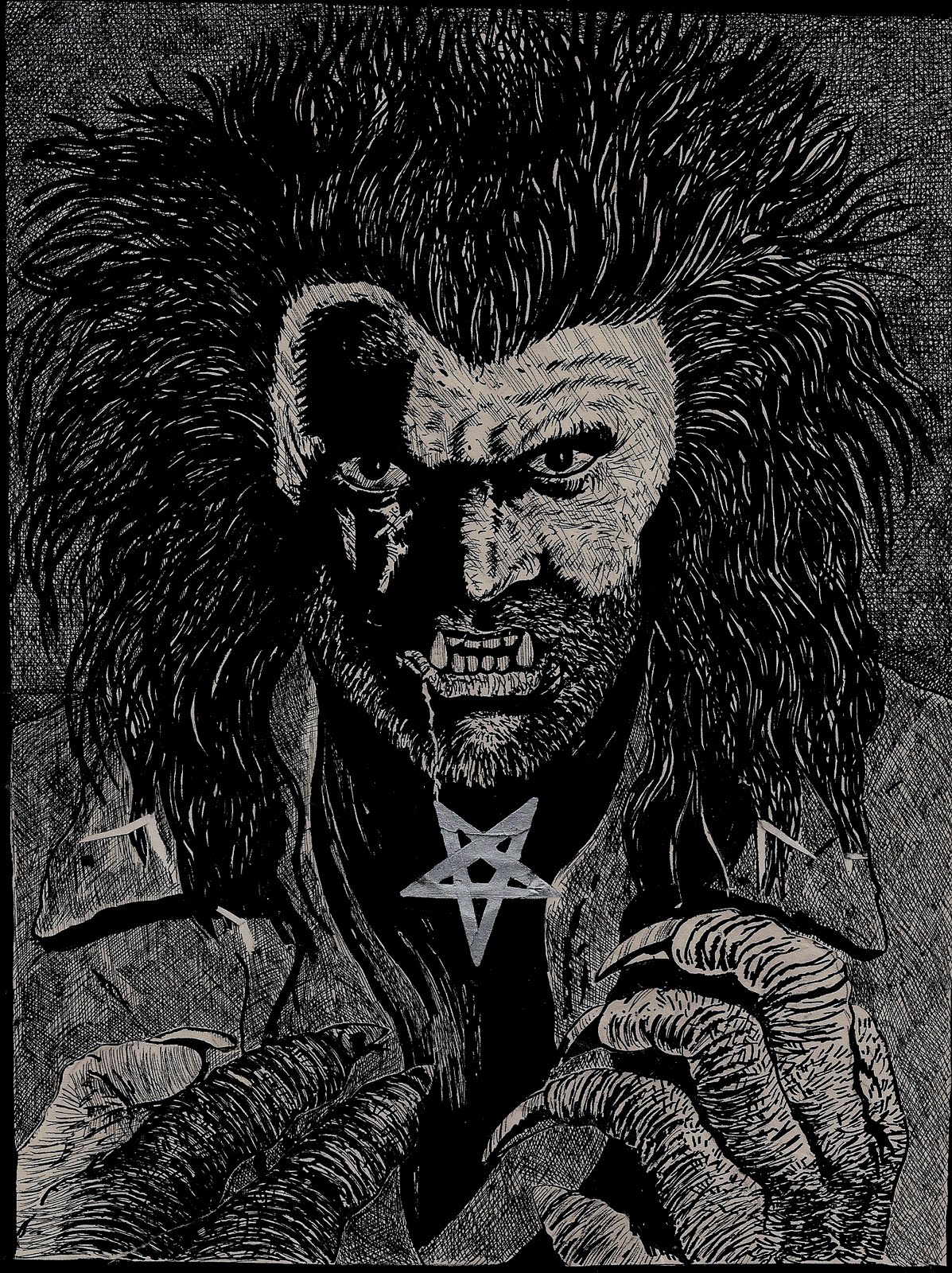
Few mythical creatures in the pantheon of world wide folklore have as much enduring popularity as the werewolf. Since the time of the ancient Greek’s stories of savage half-wolf-half-human creatures have persisted and even in today’s ultra technological age it is still possible to find vestiges of this ancient superstition in the more remote regions of France and Eastern Europe. The word “werewolf” is old Anglo-Saxon for man-wolf. In the folklore of medieval England these bestial creatures were closely associated with witchcraft and black magic. It was generally believed in these times that witches possessed the knowledge to prepare ointments which when rubbed on the skin enabled them to take the shape of wolves. Thus transformed they would then roam the countryside killing animals and any unfortunate human who crossed their path.
There are countless stories of werewolves in the folklore of France, Spain, and Eastern Europe, but in Britain the werewolf is a comparatively rare beast. This is possibly because wolves have been extinct in these isles for hundreds of years and consequently many dark tales associated with them have been lost to antiquity. However, in certain parts of Britain the werewolf legend faintly lingers. For example in Lincolnshire, as recently as the late 19th century, in a village near Northorpe, it was said that an old lame man reputed to be a wizard, was seen to change into a vicious canine creature and attack his neighbour’s cattle.


More sinister perhaps is the following tale of werewolfism in the county related by my friend and fellow student of folklore Christopher Gask.
In the 18th century, in the village of Gedney Dyke, an old woman acquired the reputation of a witch, as in the case of many old women who lived alone in remote, sparsely populated areas. At that time rumour usurped reason and it was said that she had the evil eye. Consequently her house was shunned by the locals. In a village nearby a youth named John Culpepper had developed a crush on a local girl called Rose Taylor who spurned his advances, as his reputation was that of the village idiot this was perhaps not surprising. The final straw was reached at a local fair when Rose publicly ridiculed him. He had heard stories of Old Mother Nightshade of Gedney, and though she was reputed to harm anyone foolish enough to venture near her dwelling, even those who unwisely sought supernatural council with her, Culpepper went to see her any way; well he wasn’t known as the village idiot for nothing!
The hapless half-wit duly arrived at the infamous cottage, and surprisingly was received by a cheerful old woman who appeared to be hurt and bemused by her undeserved ostracism, although she did admit to having “certain powers” Emboldened by this reception, john poured out his tale of rejection. The old woman listened thoughtfully then she said, “Young man, I will help you, but you must do what I say.” She handed him a wrapped box which he was to present to Rose on her birthday and after he was to return to the old woman for further instruction. Seven days later the girl of his thwarted dreams found an additional parcel amongst her presents; a box containing a selection of sweetmeats which she ate and thoroughly enjoyed. That evening John set out for the old woman’s house convinced that soon all would make sense and vengeance would be his. Once more she received him like a long- lost son and kept him talking long into the night. Just when he was beginning to think that she had forgotten why he was here, she said: “Now I shall reveal the secret of your revenge, but you must let me do it in my own way and not question what I do, however odd.” John agreed to this, by this time he would have agreed to anything, and at her bidding sat back and closed his eyes. When he reopened them he was firmly tied to the chair with the old woman standing over him. “You poor weak fool.” she croaked “did you really think I would help a worthless simpleton like you? Those sweets you gave to the girl were just sweets and nothing more, but now I have a present for you.” As she said these words her wrinkled visage began to twitch and shudder horribly, this spread throughout her entire frail frame, and before the boy’s incredulous eyes a macabre metamorphosis was taking place; limbs miraculously stretched and altered shape. Her extremities too were changing, fingers and toes elongating, her nose extended into a snout and thick fur grew over her wrinkled skin. Finally, the transformation from biped to quadruped was complete and before John’s disbelieving eyes stood a huge grey wolf. The beast pounced and the screams and inhuman growls that ensued could be heard in the village, but no one had the nerve to investigate until day light when a large party set out.
Outside Old Mother Nightshade’s dwelling were a series of giant paw prints heading away from the cottage. Within were the mangled remains and assorted viscera of what had once been John Culpepper. The parson was summoned but refused to confirm that this was the result of witchcraft. The frightened villagers then took matters into their own hands and put the accursed home of Mother Nightshade to the torch. When the conflagration subsided not a trace of the building or its gruesome contents remained.
Today, some 250 years later, there are still those in Gedney Dyke who claim that the howl of a wolf can be heard on the moonlit nights.


Saturday, 19 June 2010

Bayards Leap

According to folklore, these four horseshoes recall a prodigious leap made by a knight`s steed during a fight to the death with a malignant witch called Old Meg.

Now read the legend of Bayards Leap

The hamlet of Byards Leap, near Sleaford, is situated along the busy B1209 to Cranwell and is best known for it’s RAF College. It is also the setting for one of Lincolnshire’s most enduring legends. Long ago when the area was a wild and desolate tract of land, there lived an evil witch known as Old Meg, who was the terror and scourge of both man and beast. At length a champion emerged who vowed to rid the district of her. In some versions he is a Cromwellion solider, in others a chivalrous knight, and in yet another he is the witches former lover, but whatever the hero’s guise the components of the tale are the same. The man had the pick of a dozen horses on which to ride to battle. Realizing that whichever mount he chose needed to be quick and alert, he devised a plan to test their reactions. While the horses drank at the village pond he tossed a large pebble into the water and noticed the quickest to react to the splash was a horse called Blind Byard. He took this as a good omen, because a blind horse would not be scared by the loathsome appearence of the witch. The hero mounted Bayard and, armed with a sword, he rode to Old Meg`s den and called out to her. In answer, a sepulchral voice replied mockingly:
I must suckle my cubs (children) I must buckle my shoes, and
Then I will be with you my Laddie.”
No sooner had these words been uttered than the door of the hovel burst open and the witch appeared. On her hands and feet, Old Meg wore razor sharp, Freddy Kruger-style claws. But before she could use them, the rider slashed down with his sword and sheered off her left breast. Howling in pain and anger, the witch sprang towards her assailant, digging her claws into Byard`s flanks. The horse reared up in pain and made an almighty leap of some 60 feet, dislodging the hideous hag, who fell headlong to the ground. Seizing his chance, the champion ran her through with his sword this time killing her outright. However, the death blow was so forceful that the blade passed clean through the witch and mortally wounded the gallant Byard. Old Meg was taken to the crossroads and buried in the time-honored fashion, with an iron stake hammered through her black heart. The man returned to the village a hero, and the grateful villagers set up a memorial to mark Byard`s prodigious leap.

The impression where his hooves struck the ground are marked by a set of four horseshoes set in concrete. They can be found by the side of the Leadenham to Sleaford road.


The Irby Boggle

On All Saint`s Day (November 1)1455, Rosamund Guy and Neville Randall, a young couple on the eve of their wedding went for a walk in Irby Dale Woods, a beauty spot some six miles west of Grimsby. When they failed to return a search was made but neither of them was ever seen again. Just what happened that evening is not known to this day, but it was widely suspected that after a terrible quarrel, the man murdered his fiancée and then fled the village never to be seen again. The girl`s father swore that unless he was brought to justice her ghost would haunt the Irby Dale Wood for five hundred years. It was once strongly believed that the apparition dressed in her white wedding dress walks the dale woods at night and it is said that many years after the couple vanished, workmen widening a gateway to the woods uncovered a woman`s skeleton beneath the shade of an ancient oak still baring Rosamund and Neville`s initials.

Monday, 28 September 2009

Phantom in the Fog

One of the most frequent questions I have been asked over the years is "have you ever seen a ghost?" to which I have to reply in all honesty '"No". Having said this however, allow me to tell you of my own encounter with something possibly supernatural in origin .

On a visit to Skegness some time ago, I met up with an old friend of mine who I hadn`t seen for quite a while. We got reminiscing about the past and during the course of our conversation we spoke of the strange incident of which I am about to tell.

Some twenty odd years ago I lived in a shoddy one-roomed bed sit on Skegness sea front. By contrast my Friend Chris lived on the very edge of the Gibraltar Point Nature Reserve, a beauty spot a few miles from the town.

Then as now I enjoyed going on long solitary walks in the countryside. But in those days it was one of the few ways of escaping the claustrophobia of my tiny bed sit, and the hoards of noisy holiday makers that crowded the streets and pubs of Skegness during the busy summer months.

One evening on one of my solitary outings, I found myself near the golf course to the south of the town, beyond it lay a long narrow unlit road leading to the Gibraltar Point Nature Reserve. It was starting to get dark and a thick mist was rolling in from the sea but without thinking of time or distance I decided to press on for the reserve. As I have already mentioned Chris lived on the very edge of the nature reserve and since I was heading that way I decided to call him from a nearby phone box to ask him if he would care to join me on my pointless meander. As luck would have it Chris was at home, he had nothing better to do so it was arranged that he would set off and meet up with me on the road roughly half way to the reserve.

I continued at a brisk pace, and soon the last of the street lights receded into the distance behind me, while ahead lay a dark narrow unlit road made less inviting by an ever worsening fog. After walking some distance, the fog became so bad that my visibility had decreased to only a few feet and I could not distinguish the road from the verge. Concerned by the obvious dangers posed by traffic, I started to regret undertaking such a pointless and increasingly hazardous journey, and I would have certainly turned back were it not for the knowledge that by now Chris was somewhere on the road up ahead. I stopped for a while to get my bearings, and it was then that I heard the unmistakable sound of heavy hoof-beats fast approaching. Who on earth was out riding a horse in this weather? I thought and as the galloping got nearer I felt the first intimations of fear.

I was on the narrowest section of the road, and I was sure the horse and its reckless rider would be unable to see me in the dense fog. So in my panic I stumbled blindly on to the verge, aware that each faltering step I took could send me tumbling into a barbed wire fence or worse, a deep water filled ditch. I stood motionless as the hoof-beats thundered passed, the sound was so close that despite the fog I could see where the horse should have been but there was nothing! As the galloping receded into the distance I resumed my journey feeling both puzzled and unnerved by the experience.

I pressed on till I almost collided with a figure in the fog walking in the opposite direction. It was Chris he was equally shaken, as he had just had exactly the same experience further up the road. But our conversation was interrupted when the ethereal sound of hoof beats returned. But this time the drumming of hoof-beats now seemed to be circling us at an impossible speed, getting louder and louder one moment and then fading into the distance the next. Not wishing to hang around a moment longer, we headed back to chris` house as fast as the going would allow us.

Later we puzzled over the incident. We were in no doubt that we had both heard a horse in full gallop out there on the road, yet there was nothing to account for it. At length however, we decided that the fog had played tricks on our judgement of distance, and in time the incident was all but forgotten.

That is until some twelve years later when I was now living in Lincoln and working as a city tour guide. One afternoon I was swotting up on local history in the reference section of the public library, when by chance I came across a cutting from an unspecified publication, that provided one possible tantalising clue to the mystery. You can imagine my surprise when I read the following:

" A legend dating from the 1700`s has it that a farmer, on his way home from Gibraltar Point to Skegness market, tried to take his horse on a short cut along the beach, but lost his way in the fog and was drowned at high tide. Since then it is said that the frenzied sounds of ghostly hoof-beats have been heard at Gibraltar Point on foggy nights."