Saturday, 19 June 2010

Bayards Leap

According to folklore, these four horseshoes recall a prodigious leap made by a knight`s steed during a fight to the death with a malignant witch called Old Meg.

Now read the legend of Bayards Leap

The hamlet of Byards Leap, near Sleaford, is situated along the busy B1209 to Cranwell and is best known for it’s RAF College. It is also the setting for one of Lincolnshire’s most enduring legends. Long ago when the area was a wild and desolate tract of land, there lived an evil witch known as Old Meg, who was the terror and scourge of both man and beast. At length a champion emerged who vowed to rid the district of her. In some versions he is a Cromwellion solider, in others a chivalrous knight, and in yet another he is the witches former lover, but whatever the hero’s guise the components of the tale are the same. The man had the pick of a dozen horses on which to ride to battle. Realizing that whichever mount he chose needed to be quick and alert, he devised a plan to test their reactions. While the horses drank at the village pond he tossed a large pebble into the water and noticed the quickest to react to the splash was a horse called Blind Byard. He took this as a good omen, because a blind horse would not be scared by the loathsome appearence of the witch. The hero mounted Bayard and, armed with a sword, he rode to Old Meg`s den and called out to her. In answer, a sepulchral voice replied mockingly:
I must suckle my cubs (children) I must buckle my shoes, and
Then I will be with you my Laddie.”
No sooner had these words been uttered than the door of the hovel burst open and the witch appeared. On her hands and feet, Old Meg wore razor sharp, Freddy Kruger-style claws. But before she could use them, the rider slashed down with his sword and sheered off her left breast. Howling in pain and anger, the witch sprang towards her assailant, digging her claws into Byard`s flanks. The horse reared up in pain and made an almighty leap of some 60 feet, dislodging the hideous hag, who fell headlong to the ground. Seizing his chance, the champion ran her through with his sword this time killing her outright. However, the death blow was so forceful that the blade passed clean through the witch and mortally wounded the gallant Byard. Old Meg was taken to the crossroads and buried in the time-honored fashion, with an iron stake hammered through her black heart. The man returned to the village a hero, and the grateful villagers set up a memorial to mark Byard`s prodigious leap.

The impression where his hooves struck the ground are marked by a set of four horseshoes set in concrete. They can be found by the side of the Leadenham to Sleaford road.


The Irby Boggle

On All Saint`s Day (November 1)1455, Rosamund Guy and Neville Randall, a young couple on the eve of their wedding went for a walk in Irby Dale Woods, a beauty spot some six miles west of Grimsby. When they failed to return a search was made but neither of them was ever seen again. Just what happened that evening is not known to this day, but it was widely suspected that after a terrible quarrel, the man murdered his fiancée and then fled the village never to be seen again. The girl`s father swore that unless he was brought to justice her ghost would haunt the Irby Dale Wood for five hundred years. It was once strongly believed that the apparition dressed in her white wedding dress walks the dale woods at night and it is said that many years after the couple vanished, workmen widening a gateway to the woods uncovered a woman`s skeleton beneath the shade of an ancient oak still baring Rosamund and Neville`s initials.

Monday, 28 September 2009

Phantom in the Fog

One of the most frequent questions I have been asked over the years is "have you ever seen a ghost?" to which I have to reply in all honesty '"No". Having said this however, allow me to tell you of my own encounter with something possibly supernatural in origin .

On a visit to Skegness some time ago, I met up with an old friend of mine who I hadn`t seen for quite a while. We got reminiscing about the past and during the course of our conversation we spoke of the strange incident of which I am about to tell.

Some twenty odd years ago I lived in a shoddy one-roomed bed sit on Skegness sea front. By contrast my Friend Chris lived on the very edge of the Gibraltar Point Nature Reserve, a beauty spot a few miles from the town.

Then as now I enjoyed going on long solitary walks in the countryside. But in those days it was one of the few ways of escaping the claustrophobia of my tiny bed sit, and the hoards of noisy holiday makers that crowded the streets and pubs of Skegness during the busy summer months.

One evening on one of my solitary outings, I found myself near the golf course to the south of the town, beyond it lay a long narrow unlit road leading to the Gibraltar Point Nature Reserve. It was starting to get dark and a thick mist was rolling in from the sea but without thinking of time or distance I decided to press on for the reserve. As I have already mentioned Chris lived on the very edge of the nature reserve and since I was heading that way I decided to call him from a nearby phone box to ask him if he would care to join me on my pointless meander. As luck would have it Chris was at home, he had nothing better to do so it was arranged that he would set off and meet up with me on the road roughly half way to the reserve.

I continued at a brisk pace, and soon the last of the street lights receded into the distance behind me, while ahead lay a dark narrow unlit road made less inviting by an ever worsening fog. After walking some distance, the fog became so bad that my visibility had decreased to only a few feet and I could not distinguish the road from the verge. Concerned by the obvious dangers posed by traffic, I started to regret undertaking such a pointless and increasingly hazardous journey, and I would have certainly turned back were it not for the knowledge that by now Chris was somewhere on the road up ahead. I stopped for a while to get my bearings, and it was then that I heard the unmistakable sound of heavy hoof-beats fast approaching. Who on earth was out riding a horse in this weather? I thought and as the galloping got nearer I felt the first intimations of fear.

I was on the narrowest section of the road, and I was sure the horse and its reckless rider would be unable to see me in the dense fog. So in my panic I stumbled blindly on to the verge, aware that each faltering step I took could send me tumbling into a barbed wire fence or worse, a deep water filled ditch. I stood motionless as the hoof-beats thundered passed, the sound was so close that despite the fog I could see where the horse should have been but there was nothing! As the galloping receded into the distance I resumed my journey feeling both puzzled and unnerved by the experience.

I pressed on till I almost collided with a figure in the fog walking in the opposite direction. It was Chris he was equally shaken, as he had just had exactly the same experience further up the road. But our conversation was interrupted when the ethereal sound of hoof beats returned. But this time the drumming of hoof-beats now seemed to be circling us at an impossible speed, getting louder and louder one moment and then fading into the distance the next. Not wishing to hang around a moment longer, we headed back to chris` house as fast as the going would allow us.

Later we puzzled over the incident. We were in no doubt that we had both heard a horse in full gallop out there on the road, yet there was nothing to account for it. At length however, we decided that the fog had played tricks on our judgement of distance, and in time the incident was all but forgotten.

That is until some twelve years later when I was now living in Lincoln and working as a city tour guide. One afternoon I was swotting up on local history in the reference section of the public library, when by chance I came across a cutting from an unspecified publication, that provided one possible tantalising clue to the mystery. You can imagine my surprise when I read the following:

" A legend dating from the 1700`s has it that a farmer, on his way home from Gibraltar Point to Skegness market, tried to take his horse on a short cut along the beach, but lost his way in the fog and was drowned at high tide. Since then it is said that the frenzied sounds of ghostly hoof-beats have been heard at Gibraltar Point on foggy nights."

Friday, 21 August 2009

See my article "Paranormal Lincs" in the latest edition of "Paranormal" magazine (September issue 39)

The Haunted Highway


Two friends of mine recently told me of their encounter on the road with what they could only describe as a "ghost". It happened on a clear frosty night in February 2003, when the couple were driving along the A1086 road to the village of Grasby to collect their daughter from her grandparents house. As they approached a turning leading to the village of Ownby a figure with its head bowed and "wearing a kind of tweed-patterned overcoat with the hood up "Stepped from the verge straight out in front of them. There was a screech of brakes and they could only watch helplessly as an imminent collision between car and hapless jay-walker was inevitable. The impact never came however, because the figure simply vanished into thin air. They stopped the car and got out to look but the road was empty and deserted. The couple have since found out that years earlier the body of a murder victim was found close to the spot where the apparition appeared.

My Friends` unnerving encounter has prompted me to recount the following purportedly true stories of paranormal happenings on some of Lincolnshire`s highways and byways. Starting with a haunting that took place in the 1950`s on the A16. near the hamlet of Walmsgate. Motorists travelling this stretch of road reported seeing a green glowing mist come out of an old sandstone pit, which then drifted across the road and disappeared onto fields on the other side. The place became known as "Green man Pit" because the mist, according to some was said to take the shape of a man. One night a driver travelling towards Walmsgate stopped his car when he saw a glowing green figure emerge from a copse and onto the road in front of him. The figure dashed towards the car and the terrified driver could only watch in disbelief as the apparition ran straight passed him and disappeared into the night. It is interesting to note that a Neolithic long barrow, the biggest in the county and said to be the grave of a dragon slain by a local knight in the 12th century, is situated just north of the road here. Such ancient sites have long been associated with paranormal activity. A more recent encounter with a phantom of the road occurred in June 2006, when two holiday makers from Leicester reported seeing an old man wearing "A Jacket, trousers and a cloth cap that looked to be from the turn of the century" riding an equally old fashioned looking bicycle along the middle of the Louth bypass. It happened in the afternoon between London Road and the A157 roundabout. They said the man was only a short distance in front of them but when they drove closer both cycle and cyclist vanished into thin air.


Sightings of the ubiquitous phantom coach and horses have become increasingly rarer since the advent of the motor car, but they are still occasionally reported. For example a lady driving along the A169 between Louth and Grimsby related her experience of this phenomenon to Jared Williams in the "Lincolnshire Life" of April 1985. She said: "I was driving down to Grimsby just as day was breaking. As I approached the village of Waithe I was surprised to see a horse-drawn cab ahead of me and going in the same direction. As it had no lights I thought I `d better over take and tell the driver. I did so. But when I looked in the driving mirror the road was empty. And there was no turning this cab could have taken."

Much has been written over the years about the ghostly Green Lady that haunts Thorpe Hall, a Tudor mansion situated near Louth. The ghost is said to be the shade of a beautiful Spanish noble woman who was taken prisoner after the battle of Cadiz in 1595 , by Sir John Bolle, the then owner of Thorpe Hall. It is said that during her captivity the lady fell in love with Sir John, and according to one dubious legend she killed herself when her love for him was unrequited. The fact she never visited Thorpe Hall (nor England) during her life time, has not stopped reports of her ghost dressed in green (giving rise to her being called the Green Lady) haunting the hall and its environs down through the centuries. The Reverend HJF Arnold, a former vicar of Wainfleet, had a most strange encounter with green lady ghost, because he claimed to have seen her on a road many miles from her usual haunting ground of Thorpe Hall. It happened on a rainy December evening in 1935, as the Revd was driving to Aisthorpe, near Lincoln. Suddenly in the glare of his headlamps he saw a woman step into the road in front of him: "Alarmed lest I should run into her I applied my brakes and stopped. I took my eyes off her for a second while getting into neatral gear and in that second she had disappeared. Revd Arnold was later convinced the woman he saw "dressed in green silk, a tight bodice and flowing skirt, with bare head, arms and neck, was none other than the Green Lady of Thorpe Hall. He based this assumption on a rather tenuous conection that a manssion belonging to a relative of Sir John Bolle had once stood at nearby Scampton.

Not all spectres of the road take human form. At "Double Tunnels" between Fulstow and North Thoresby it was said that " something used to role across the road and frighten horses". Nobody liked to drive there at night and many accidents occurred where the thing was seen.

More traditional road hauntings include the sounds of a ghostly horse and cart in Ings Lane Utterby, and in the same village a ghostly woman in a cloak has been seen running across the road in Pear Tree Lane. There are also a variety of headless ghosts including a headless bride who walks the lanes of Scremby at midnight, and the phantom coach of Ostlers Lane Maidenwell, with a driver who keeps his own severed head on a seat besides him. However, none of the above have been seen to my knowledge within living memory and I suspect they are folklore rather than actual phenomenon. Unless of coarse you know different!


Tuesday, 28 July 2009

Haunted Trees


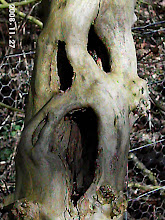
I took these photographs of a weird looking tree stump when out walking in woodlands last autumn. Not only did its strange configurations remind of the mask worn by the various killers in the scream movies, but it also reminded me of the once common superstition that certain tress had an attraction for evil spirits.

A letter dated 7th July 1606, gives an account of one such haunted tree at Brampton, near Gainsborough. The letter states:

"An ash-tree shaketh in body and boughs thereof, sighing and groaning like a man troubled in his sleep, as if it felt some sensible torment. Many have climbed to the top of it, who heard the groans more easily than they could below."

At length the Earl of Lincoln had one of the arms of the ash lopped off and a hole bored through the trunk. This caused the hollow voice from within to be heard more audibly than before, but in a kind of speech that nobody could understand.


The Suicide Tree

In Fishtoft near Boston, an ancient Hawthorn tree, once stood at a road junction leading to Tower Lane and Fishtoft church. Once a local land mark, the tree is mentioned in the Fishtoft Acre Books for 1662, 1733 , and 1733, and it was once shown on a map of the area. Those travelling the low road to Frieston in years gone by Knew the tree well, but sadly much of the folklore attached it is now lost to antiquity. However, in "The History and Antiquities of Boston" (1856) author Pishey Thompson claimed that the tree grew from the stake driven into the grave of a suicide buried at the crossroads, a memorial that was common centuries ago.

Thompson says: '' We have heard of the name of the particular female said to have been ignominiously interred here and many particulars respecting her, more than a century ago; but do not recollect them."